
The beginning of a journey
Disclaimer: This is a work of fiction. Any names or characters, businesses or places, events or incidents, are fictitious. Any resemblance to actual persons, living or dead, or actual events is purely coincidental.
Joe sighed deeply as he stared out the window, looking over the bustling city below.
It had been another long week at the office, filled with stressful deadlines, inter-team arguments, and an ever-growing list of unfinished tasks.
As head of the product development team, it was his job to keep morale high and work flowing smoothly.
But lately, it seemed like maintaining positivity and collaboration was an uphill battle.
Everyone was feeling the pressure from upper management to deliver new features quickly.
What should have brought the team together for a shared purpose was instead driving wedges between teammates.
Joe wondered how they had gotten to this point—where simple slips or alternative ideas were met with intense critique rather than understanding.
He wanted their meetings to be a place where people could recharge through supportive teamwork, not dread due to defensiveness and disharmony.
A chime on Joe’s computer alerted him to the upcoming team meeting.
Taking a deep breath, he pushed away from his desk to join the others, hoping today might yield a breakthrough.
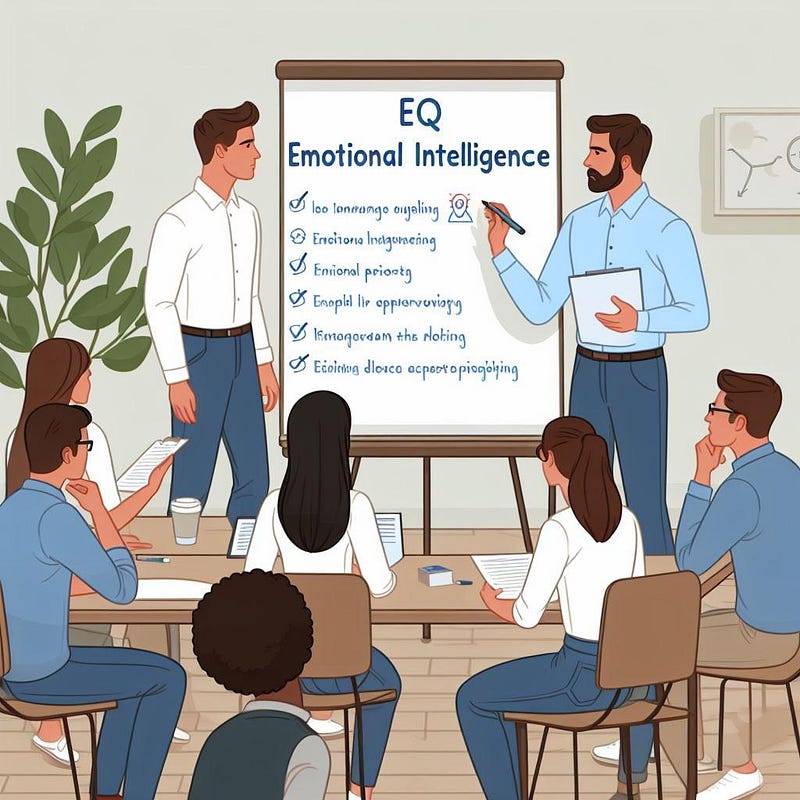
As they gathered around the large table laden with half-drunk coffees and scattered notes, Joe began by explaining a new initiative—an emotional intelligence training programme designed to strengthen relationships and work culture from the inside out.
What is EQ and Why Does it Matter?
Emotional intelligence, or EQ, refers to the ability to recognise and manage personal emotions and the emotions of others, according to various psychological frameworks.
It encompasses self-awareness about one’s feelings and how they influence behaviour, as well as social skills like empathy, conflict resolution, and inspiration.
Research has demonstrated EQ’s importance for both individual well-being and team and organisational success.
People with a higher EQ experience lower stress levels since they can regulate intense emotions more adaptively.
They also tend to be better leaders due to poor conflict management and the ability to motivate others even during difficult periods.
Academic studies further show EQ correlates positively with job performance, particularly for roles requiring social interaction and problem-solving.
Teams that score high on emotional intelligence measures often outperform their low-EQ counterparts in areas like collaboration, innovation, and weathering change.
Customer satisfaction is likewise higher when service providers understand customers’ perspectives and moods.
Armed with this background, Joe explained to his team that investing in EQ development could yield substantial payoffs for both individuals and the whole unit.
While a few remained sceptical, most seemed willing to try a short training programme if it truly offered hope of turning things around.
Building Awareness through Shared Experience
The first EQ sessions focused on awareness, helping each person understand their own emotional patterns and reactions more clearly.
Light roleplays initiated difficult yet valuable conversations about hot button issues, biases, and unreconciled conflicts simmering below the surface.
As revelations emerged, hard truths were balanced with empathy and forgiveness.
People realised even seemingly trivial interactions held deeper meanings for others depending on personal experiences.
Slowly, defence mechanisms broke down, and authentic listening began to take root as safety within the group grew.
Over subsequent weeks, attention shifted to active perspective-taking and addressing emotions constructively.
Complex scenarios inspired animated yet peaceful debates integrating multiple viewpoints.
The team recognised that more viewpoints often co-exist within an issue than a single right answer, softening previously inflexible stances.
By openly discussing struggles too, a spirit of shared vulnerability developed where weakness became strength.
Rather than isolation, setbacks elicited group problem-solving, and encouragement and negative thoughts could be reframed positively.
Meetings transitioned from a chore to something uplifting as human bonds strengthened.
Reaping Rewards of Personal Growth
Before long, palpable changes emerged across daily operations.
Conflict de-escalated naturally as priorities were aligned around collective well-being rather than individual agendas.
Creative solutions blossomed from diverse cooperation instead of stale compromise.
People felt truly seen and heard, energised instead of drained.
Productivity soared as intrinsic motivation replaced external pressures and stress melted away through emotional support networks.
Customers quickly took note of the team’s improved patience, positivity, and solution-focused mindset.
Successful launches that had once seemed implausible amid strife now manifest with remarkable ease and satisfaction.
As the journey progressed, so did understandings of oneself and others.
But the richness lay not in mastery but in meaning found through shared imperfection and learning from fellow travellers.
In forging true connections between souls, the team uncovered an invaluable wellspring for navigating any challenge as one.
Thanks for reading…
If you enjoyed reading my story, please highlight any parts you think other readers would find interesting.
Don’t forget to leave your comments about what you thought of this story.
Consider following me here on Medium and subscribing to my stories.
Discover more from nom@d learning
Subscribe to get the latest posts sent to your email.
 nom@d learning
Leave a comment