

We all face moments when our inner voice becomes our worst enemy, right?
It’s that nagging whisper that tells us we’re not good enough, smart enough, or talented enough to achieve our dreams.
This negative self-talk can be a major roadblock on the path to success and happiness, but the good news is that it’s a habit that can be broken.
With the right strategies and a little bit of practise, you can learn to silence your inner critic and cultivate a strong, unwavering sense of self-confidence.
Negative self-talk is like a weed that takes root in the fertile soil of our minds.

Past experiences, childhood traumas, or societal pressures plant it as a tiny seed.
Over time, if left unchecked, that seed can grow into a tangled mess of self-doubt and self-criticism that overshadows our true potential.
For many of us, negative self-talk stems from past experiences that have left us feeling inadequate or unworthy.
Perhaps you were bullied as a child, or you grew up in a household where criticism was more common than praise.
These early experiences can shape the way we see ourselves and create a lens of negativity through which we view the world.
In addition to our personal histories, societal pressures can also contribute to negative self-talk.
We live in a world that often equates worth with accomplishment and success with material possessions.
When we compare ourselves to these unrealistic standards, it’s easy to feel like we’re falling short.
Social media has only amplified the comparison trap.

As we scroll through our feeds, we’re bombarded with images of people living seemingly perfect lives—exotic vacations, dream jobs, picture-perfect relationships.
But it’s important to remember that social media is a highlight reel, not the whole story.
Behind every carefully curated post, there’s a real person with real struggles and insecurities, just like you.
The good news is that just as negative self-talk can be learned, positive self-talk can be practised and mastered.
By consciously choosing to focus on your strengths, your accomplishments, and your potential, you can gradually rewire your brain for confidence and success.

This rewiring process is possible thanks to the brain’s remarkable ability to change and adapt, a phenomenon known as neuroplasticity.
Every time you engage in positive self-talk, you’re strengthening the neural pathways associated with confidence and optimism.
Over time, these pathways become the default, making it easier and more automatic to think positively about yourself.
One of the most effective ways to practise positive self-talk is through the mirror technique.
Each morning, stand in front of a mirror, look yourself in the eye, and say something positive about yourself.
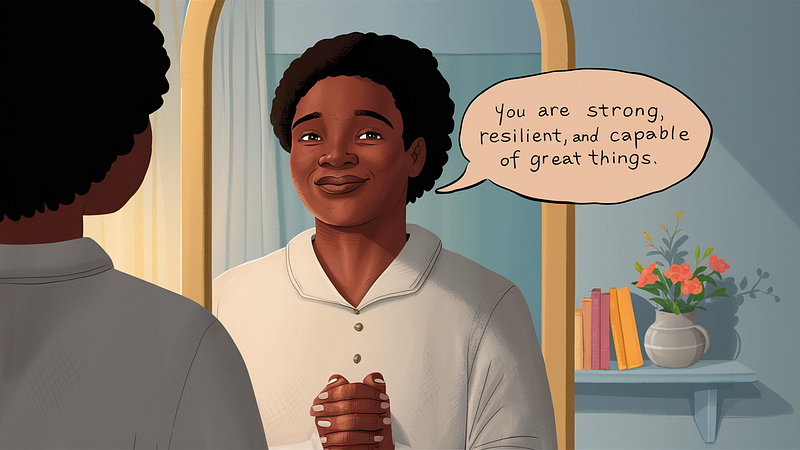
It might feel awkward or even silly at first, but stick with it.
Start with simple affirmations like, “I am capable of handling whatever challenges come my way today”
-or-
“I am worthy of love and respect.”
As you become more comfortable with the practise, you can move on to more specific and personal affirmations.
Another powerful tool for cultivating positive self-talk is a gratitude journal.

Each night before bed, take a few minutes to write down three things you’re grateful for.
They can be big things, like a supportive partner or a fulfilling career, or small things, like a beautiful sunset or a cosy cup of tea.
By consistently focusing on the good in your life, you train your brain to seek out and appreciate the positive.
Of course, even as you practise positive self-talk, that inner critic is likely to pipe up from time to time.
The key is to recognise these negative thoughts for what they are—just thoughts, not facts—and to have strategies in place for dealing with them.
When you catch yourself engaging in negative self-talk, the first step is to give yourself a reality check.
Ask yourself, “Is this thought really true? Is there evidence to support it?”
Often, our negative self-talk is based on exaggerations, generalisations, or outright falsehoods.
By questioning these thoughts, we can start to chip away at their power.
Another effective strategy is to reframe negative thoughts in a more positive or neutral light.
For example, instead of thinking, “I’m so bad at this,” try, “I’m still learning and improving.”
Instead of, “I’ll never be able to do this,” try, “This is challenging, but I’m up for the challenge.”
By shifting your language, you can shift your mindset.
Perhaps the most important strategy for silencing your inner critic is to practice self-compassion.
Treat yourself with the same kindness, understanding, and forgiveness that you would extend to a dear friend.

When you stumble or fall short, instead of beating yourself up, remind yourself that everyone makes mistakes and that each misstep is an opportunity to learn and grow.
While positive self-talk is a crucial piece of the confidence puzzle, it’s not the whole picture.
To truly cultivate unshakable self-confidence, you need to couple your positive thoughts with positive actions.
One of the best ways to build self-confidence is to set and achieve goals for yourself.
Start small, with goals that are challenging but achievable.
As you check each goal off your list, you’ll get a boost of confidence and motivation that will propel you forward to your next target.
Of course, not every goal will be met on the first try.
Failure is a natural and inevitable part of the growth process.
The key is to view these setbacks not as reflections of your worth or ability but as valuable learning experiences.
Each time you stumble, ask yourself, “What can I learn from this? How can I use this experience to improve and grow?”
Just as important as learning from your failures is celebrating your successes.

When you achieve a goal, big or small, take a moment to savour the accomplishment.
Treat yourself to something you enjoy, share the good news with a supportive friend, or simply take a few minutes to reflect on how far you’ve come.
By acknowledging and celebrating your wins, you reinforce the belief that you are capable, competent, and worthy of success.
Finally, one of the most powerful ways to build self-confidence is to surround yourself with positive, supportive people.
The people we spend time with have an enormous impact on our thoughts, feelings, and beliefs about ourselves.

Seek out friends, family members, and colleagues who lift you up, believe in you, and inspire you to be your best self.
At the same time, don’t be afraid to distance yourself from negative influences — those people who constantly criticise, complain, or try to tear you down.
FAQs
Q: I’ve been struggling with negative self-talk for as long as I can remember. Is it really possible to change such a deeply ingrained habit?
Absolutely. While changing a long-standing habit like negative self-talk takes time and effort, it is entirely possible. The key is to be patient with yourself and to celebrate each small victory along the way. Remember, every time you choose a positive thought over a negative one, you’re making progress.
Q: I find it hard to believe positive affirmations about myself. They just don’t feel true. What should I do?
This is a common challenge when starting a positive self-talk practice. The key is to start with affirmations that feel authentic and believable to you, even if they’re small. For example, instead of jumping straight to “I am a confident, successful person,” you might start with something like, “I am taking steps to become more confident each day.” As you practice, you’ll start to internalise these affirmations more and more.
Q: How do I maintain a positive outlook in the face of setbacks and failures?
Setbacks and failures are a normal and inevitable part of the growth process. The key is to view them as opportunities for learning and improvement rather than as reflections of your worth or ability. When you encounter a setback, ask yourself, “What can I learn from this experience? How can I use this to become better, stronger, or wiser?”
Q: What if the people around me are negative and unsupportive of my efforts to be more confident?
Surround yourself with positive, supportive influences as much as possible. This might mean seeking out new friends or social circles or setting boundaries with negative people in your life. Remember, you have the power to choose who you allow into your inner circle. Choose people who lift you up and believe in your potential.
Q: Can improving my self-confidence really make a significant difference in my life?
Without a doubt!
Self-confidence is a foundational element of success and happiness in every area of life. When you believe in yourself, you’re more likely to pursue your dreams, take healthy risks, and bounce back from setbacks. Self-confidence can lead to better relationships, as you’ll be more likely to communicate your needs and set healthy boundaries. It can boost your career, as you’ll be more likely to advocate for yourself and seize new opportunities. And it can improve your overall well-being, as you’ll spend less time worrying and more time enjoying life.
Its a Wrap…
Negative self-talk is a thief that robs us of our joy, our potential, and our peace of mind. But by learning to recognise and reframe these negative thoughts, by practising positive self-talk and self-compassion, and by building our confidence through consistent action and celebration of our progress, we can break free from the prison of self-doubt and step into the freedom of self-love.
Remember, you are worthy, capable, and destined for great things, just as you are.
Your self-confidence is not a destination but a journey—a journey of growth, discovery, and becoming the very best version of yourself.
So keep putting one foot in front of the other, and keep choosing thoughts that lift you up and actions that propel you forward. And most of all, keep believing in the incredible, unstoppable power of you.
Thanks for reading…
If you enjoyed reading my story, please highlight any parts you think other readers would find interesting.
Don’t forget to leave your comments about what you thought of this story.
Consider following me here on Medium and subscribing to my stories.
Discover more from nom@d learning
Subscribe to get the latest posts sent to your email.
 nom@d learning
Leave a comment