
Prioritising what really matters

Take a look at the picture above. Does it look familiar?
Let me introduce Dave, a manager who was constantly feeling he couldn’t distinguish what tasks needed tackling first from ones that didn’t.
Here is his story…
Dave slumped back in his chair, rubbing tired eyes, as he took another sip from his mug of coffee.
As a new manager at his company, he felt like he was constantly treading water.
Trying to keep up with the never-ending flood of requests, meetings, and tiny tasks.
While some seemed time-sensitive, he wondered if he was focusing on the right things.
To make matters worse, he was “old school”, scribbling down things on post-it notes and forgetting where he had put them.
There had to be a better way. That’s when Dave stumbled upon an article discussing the difference between urgent tasks and important ones.
Intrigued, he dug in.
Understanding Urgent vs Important
The post explained that urgency is about immediately addressing time-dependent issues. Importance, however, measures how a task contributes to your long-term objectives and goals.
- For example, an urgent matter needs completion in the next hour. But it may not align with your broader aims and therefore lacks importance.
- Conversely, a task may lack urgency yet remain vital to your aspirations.
This framework could help him prioritise where to direct his energy. Dave was hooked!
If he could separate urgent from important, maybe he’d stop feeling overwhelmed.
Dave decided to put urgent vs important into practise and see what happened.
But implementing a new system would require perseverance in the face of difficulty and doubt.
His journey had just begun.
Rating and Realigning
First, Dave logged every pending task on a spreadsheet. He rated urgency from 1 to 5 and importance from 1 to 10. Analysing the results shocked him.
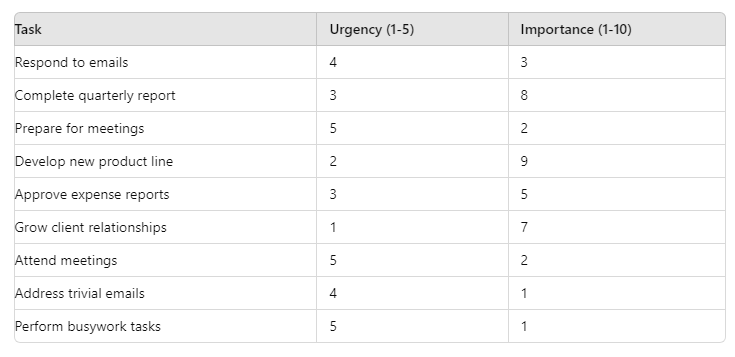
Most tasks felt pressing yet contributed little to his objectives. Meetings no one cared about. Trivial emails. Busywork assigned by others.
This urgent stuff soaked up hours without forwarding his true priorities. Dave needed an overhaul. He committed to focusing energy where it mattered most.
From now on, importance would drive decisions, not clamouring for urgency. Saying no to low-value toils would free time for high-impact missions. A new system was born.
Pushback and Perseverance
At first, asserting NO felt unnatural. Co-workers voiced surprise when Dave declined minor requests. He wondered if others saw him as lazy or unreliable.
Progress on key aims, like new products, also lagged, adding to self-doubt. Was this framework flawed? Dave nearly reverted to old habits.
But through persistence, benefits emerged. By filtering urgency, Dave stayed engaged on meaningful work. Client relationships and long-term thinking advanced steadily.
Metrics like customer retention rose each period. Reviews highlighted Dave as a top performer. His perseverance through initial discomfort was paying off.
Bursting the Bubble
Just when Dave felt most resilient, a scheduled meeting loomed — his performance evaluation. What if real results didn’t match expectations? Failure may burst his urgent vs important bubble for good.
Nerves mounting, Dave reviewed his numbers. To his surprise, minor urgent tasks existed as always, but with one huge difference: objectives were on track or exceeded.
As reviews commenced, positive feedback flooded in. Higher-ups praised Dave’s strategic thinking and visionary work. He exceeded all markers of the department’s most valued staff.
Relief washed over Dave. Separating urgent from important had generated true value, not just activity. By persisting through initial pains, he unlocked ability to achieve at new levels. His framework proved no gimmick — it worked.
The Illusion of Urgency
In reflecting, Dave realised that urgency is often an illusion meant to distract us. While pressing to-dos shriek for attention, importance drives meaningful results.
Staying fixated on minor, urgent tasks keeps ambition and progress at bay. But by filtering noise to refocus on what’s genuinely important, potential rises significantly.
For anyone feeling overwhelmed by constant demands, Dave advises testing this concept. Rate each pending task, then assert no to low importance tasks. Redirect hours to activities aligned with your objectives.
Early discomfort may arise, but with perseverance, the system works.
Prioritising importance over urgency is key to achieving more while expending far less effort along the way.
Dave hopes sharing his experience can help others unlock their potential too!
Thanks for reading…
If you enjoyed reading my story, please highlight any parts you think other readers would find interesting.
Don’t forget to leave your comments about what you thought of this story.
Consider following me here on Medium and subscribing to my stories.
Discover more from nom@d learning
Subscribe to get the latest posts sent to your email.
 nom@d learning
Leave a comment