
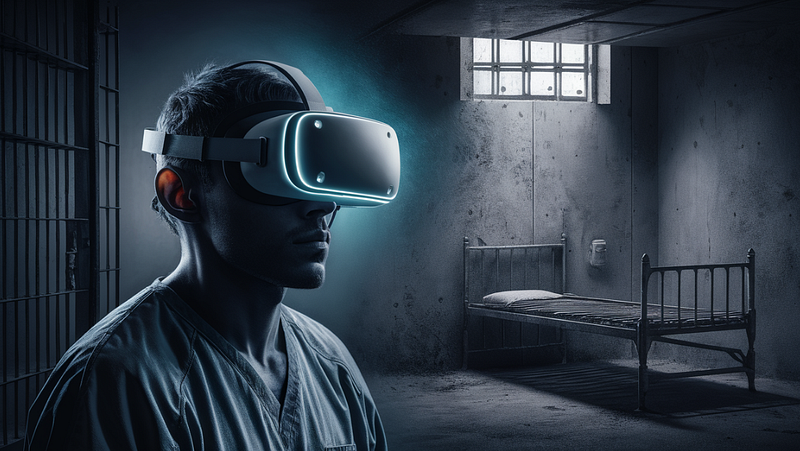
A new way to encourage positive behaviour change behind bars
As someone who worked for Court Services Victoria (Australia) for over 10 years, I am aware that prisons today face many challenges in rehabilitating inmates and reducing recidivism rates.
Overcrowding, lack of funding, and outdated rehabilitation programmes all contribute to high rates of former prisoners reoffending after release.
However, new technologies may offer innovative solutions.
After working with the Audio Visual Group (VGRS) division, I saw many innovation ideas emerging during my time with them.
I believe Virtual reality (VR) in particular shows promise as a rehabilitation tool with the power to effectively address behavioural issues through immersive experiences.
While still in its early stages, VR could transform prison rehabilitation if implemented thoughtfully.
Table of Contents
· What is the problem with traditional rehabilitation methods?
· How Could VR Help Rehabilitate Inmates?
· Some Examples of VR Being Used in Prison Rehabilitation
· Got Questions?
· Wrapping Up
What is the problem with traditional rehabilitation methods?
Prison programmes have traditionally focused on education and job training.
However, these alone often fail to address the root causes of criminal behaviour, like substance abuse, mental health problems, and a lack of job skills.
Most inmates return to the same high-risk environments after release without truly changing their behaviours or mindsets.
Traditional talk therapy sessions also have their limitations.
Openly discussing traumatic pasts or risky behaviours can be difficult for inmates in group settings. The sterile prison environment also makes truly reflecting on one’s actions challenging.
How Could VR Help Rehabilitate Inmates?
VR offers a uniquely immersive medium to potentially overcome some of the shortcomings of traditional rehabilitation methods.
- Exposure therapy. VR can safely expose inmates to high-risk situations involving substances, violence, etc. to help them build coping skills and make better choices.
- Social skills training. VR scenarios could practice appropriate social interactions, conflict resolution, empathy, and other interpersonal skills to smooth re-entry.
- Life skills simulations. From financial management to parenting, VR simulations could train vital life skills not offered in prison.
- Reliving past events. With therapist guidance, inmates may gain insight by revisiting past traumatic experiences or crimes through VR to process emotions and thoughts.
- Career exploration. VR exposes inmates to potential career paths and helps them find purpose and motivation through job training in fields like construction, healthcare, and more.
- One-on-one therapy. Through VR, inmates could feel more comfortable openly discussing sensitive issues privately with a therapist instead of in a group setting.
The immersive nature of VR helps inmates mentally engage with rehabilitation in a more meaningful way compared to traditional methods. It could help reshape behaviours from the inside out.
Some Examples of VR Being Used in Prison Rehabilitation
Prisons in several countries have started pilot programmes using VR for rehabilitation.
- Virtual reality (VR) is being increasingly used in Australian prisons as a rehabilitation tool. For instance, Queensland Correctional Services has implemented a VR programme to help inmates overcome fears and anxieties.
- Another example is the “Insight” programme, which uses VR to educate inmates about the consequences of violent behaviour.
- Additionally, VR has been used to provide inmates with a virtual tour of their release plans, helping them transition back into society more smoothly. These initiatives aim to reduce recidivism rates and improve inmates’ mental well-being during their rehabilitation journey.
- A Danish prison developed a VR construction job training simulator. Inmates learned skills to improve career prospects after release.
- Inmates at a Washington state prison used VR to practice job interviews. They received feedback on how to better present themselves to future employers.
- A Spanish prison created VR scenarios to treat sex offenders. Inmates confronted past behaviours and learned to control impulses through exposure therapy.
- A New York programme had inmates relive their crimes through VR to experience the impact on victims. Many gained new empathy and insights into making amends.
- Inmates in an Ohio prison used VR to virtually visit family from afar. This helped strengthen family bonds, which are crucial for rehabilitation.
While early, the success of these pilot programmes suggests VR has great potential if implemented systematically in prisons globally. Of course, further research is still needed.
Got Questions?
Isn’t VR just a distraction from real-world issues prisons face?
VR aims not to replace existing programmes but to enhance them.
Used as one part of a multi-faceted rehabilitation approach addressing an inmate’s specific needs, VR shows promise as a transformative tool.
It can mentally and emotionally engage inmates in their rehabilitation in a way that traditional methods often cannot.
Won’t inmates just see VR as a “fun” break from prison life?
When guided by trained professionals and incorporated thoughtfully into treatment plans, VR scenarios are purposefully designed for rehabilitation, not purely entertainment.
Therapists can help inmates process each experience to gain meaningful insights for positive behaviour change.
Isn’t VR too expensive for most prison budgets?
While initial costs may be higher than traditional methods, VR equipment prices are falling rapidly.
If pilot programmes prove successful in reducing recidivism, the long-term savings to societies from fewer reoffenders could outweigh upfront equipment investments.
Government and private grants may also help fund VR programmes, given their potential societal benefits.
How do you prevent VR from being misused by inmates?
Like any technology, VR systems would need to be carefully monitored and controlled.
Therapists could remotely oversee each session to ensure scenarios align with treatment plans.
Strict controls and no independent inmate access would be required, at least initially, until programmes are refined. As with any rehabilitation method, oversight is key.
Won’t VR just be seen as a “reward” rather than a serious rehabilitation tool?
When incorporated thoughtfully into treatment regimens by trained professionals and not simply offered as a fun distraction, inmates can be guided to view VR as a valuable part of addressing the root causes behind their criminal behaviours.
Therapists play a crucial role in ensuring each experience facilitates meaningful discussion and insight towards rehabilitation goals.
Wrapping Up
While still early in development and testing, VR shows great potential as a transformative tool for prison rehabilitation programmes globally.
Its immersive nature allows inmates to mentally engage with rehabilitation in a way traditional methods often cannot through exposure therapy, social skills training, career exploration, and more.
Of course, further research is still needed to refine best practices. And oversight will be crucial to ensuring VR is used appropriately and does not become misused or seen as merely entertainment.
However, if implemented thoughtfully as one part of well-rounded rehabilitation programmes tailored to individual needs, VR could help reshape behaviours and minds in a way that reduces recidivism and eases prisoners’ transition back into society.
Its innovative approach just may be what is needed to finally solve some of the age-old challenges facing prison rehabilitation.

Thanks for reading…
If you enjoyed reading my story, please highlight any parts you think other readers would find interesting.
A couple of claps 👏 wouldn’t go amiss, either.
Don’t forget to leave your comments about what you thought of this story.
Consider following me here on Medium and subscribing to my stories.
Discover more from nom@d learning
Subscribe to get the latest posts sent to your email.
 nom@d learning
Leave a comment