
Connect deeper and win hearts with the magic of authentic expressions
Have you ever felt that electric spark when someone truly sees you?
It’s in those moments, when we feel genuinely understood, that connection becomes more than just a word — it becomes a powerful force that shapes our relationships and self-worth.
I’m referring to more than just a casual glance or a polite nod. I mean that special moment when eye contact is made, smiles appear, and everything else fades away, leaving just the two of you.
That, my friend, is the enchanting power of genuine eye contact.
Imagine harnessing that power in every interaction — from high-stakes boardroom presentations to casual water cooler chats.
Doesn’t it sound like a superpower to you? Well, it kind of is.
Think about the last time someone held your gaze with genuine warmth — it likely made you feel seen, valued, and even a little more confident.
That’s the subtle yet powerful influence of real eye contact; it can change the entire dynamic of an interaction. And the most exciting part? It’s a skill that you can develop.
In this article I will show you how to:
- Build instant rapport with anyone, from CEOs to interns.
- Boost your charisma and influence in professional settings.
- Overcome anxiety and awkwardness in social situations.
- Master the art of nonverbal communication.
- Create memorable connections that can skyrocket your career.
Let’s clarify: this is not about manipulation or pretence. It’s about being your true, radiant self in every interaction. It’s about smiling not only with your lips but with your whole being.
Are you prepared to unleash the true power of genuine eye contact? Get ready, as we’re about to start a journey that may revolutionise how you connect with others—and yourself. Let’s get started!
🔑 Key Takeaways
- Genuine eye contact is a powerful tool for building trust and rapport.
- Smiling with your eyes can significantly improve your communication.
- Practicing authentic expression can lead to deeper relationships.
- Skills for maintaining eye contact can be learned and improved over time.
- The impact of genuine eye contact contributes to professional success as well as personal interactions.
📚 Table of Contents
· The Magic of Eye Contact
· The Science Behind the Smile
· Mastering the Art of Genuine Expressions
· Eye Contact in Professional Settings
· Overcoming Challenges and Building Confidence
· Cultural Considerations
· Got Questions?
· Wrapping Up
The Magic of Eye Contact
Picture this: It’s my first big corporate training gig. The room is packed with sceptical executives, arms crossed, eyebrows raised. I’m extremely nervous, wondering if I’ve taken on more than I can handle. Then, it happens.
I lock eyes with a particularly stern-looking gentleman in the front row.
Instead of looking away (which, believe me, I wanted to do), I hold his gaze and smile — not just with my mouth but with my whole being.
To my amazement, his expression softens. He uncrosses his arms and leans in, suddenly engaged.
That moment was a pivotal turning point. I discovered that genuine eye contact isn’t just about looking at someone; it’s about seeing them and letting them see you. It’s a silent conversation that conveys a lot.
Over the past twenty-five years or so, I’ve presented to thousands of business people, from fresh-faced interns to battle-hardened CEOs. And you know what? That magic never fades.
When you smile genuinely, people don’t just hear your words; they feel the emotion behind your message.
The Science Behind the Smile
“That’s all warm and fuzzy, but where’s the beef?” Hold onto your lab coats, as we are about to embark on a scientific adventure (in a light-hearted manner, I assure you).
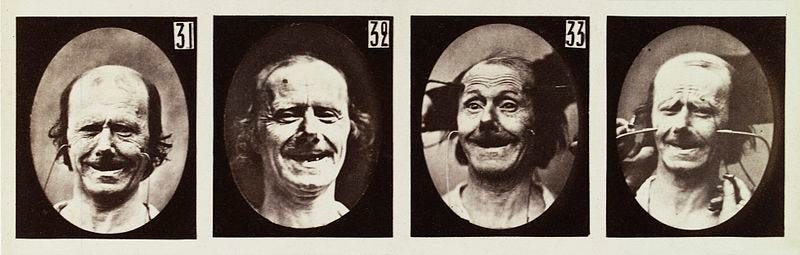
The Duchenne smile is named after the 19th-century French anatomist Guillaume Duchenne; it’s what scientists call a genuine smile.
Unlike a polite social smile, a Duchenne smile involves not just the mouth but also the muscles around the eyes. It’s those adorable crow’s feet that make all the difference.
Moreover, our brains are wired to recognise and respond to these genuine expressions. When we see a real smile, our mirror neurones fire up, making us more likely to smile back. It’s like a happy little chain reaction!
Additionally,
- Duchenne smiles activate the orbitalis oculi muscles (fancy talk for “eye crinkles”).
- Mirror neurones in our brains respond to genuine expressions.
- Authentic smiles can trigger positive emotional responses in others.
- People who display genuine smiles are perceived as more trustworthy.
- They are seen as more competent.
Genuine smiles make individuals more likeable. In the cutthroat world of business, that can be the difference between sealing the deal and getting shown the door.
Imagine walking into a high-stakes meeting — your genuine smile instantly puts the other person at ease, making you appear more approachable and trustworthy.
This small, authentic gesture can build rapport and open the door for meaningful connections, which is often the key to closing deals.
Mastering the Art of Genuine Expressions
“Hold up,” I hear you say. “I can’t just flip a switch and turn on a genuine smile!” And you’re right — authenticity isn’t something you can fake. The positive news is that it is something you can cultivate.
Over the years, I’ve developed a few tricks to help bring out those authentic expressions:
- Practice mindfulness: Before entering a meeting or presentation, take a moment to centre yourself. Focus on your breath and set a positive intention. It’s like resetting your emotions, starting fresh.
- Find your ‘happy place’: Keep a mental image of something that brings you joy. It could be your dog’s goofy grin, your kid’s laugh, or that time you nailed the karaoke version of “Don’t Stop Believin’.” Recall this image when you want to create a genuine smile.
- Use the ‘smize’: The ‘smize’ (smiling with your eyes) is a real technique. Practice in the mirror by thinking of something truly delightful and noticing how your eyes crinkle.
- Connect with your audience: Instead of seeing a room full of strangers, try to connect with individuals. Find something you appreciate about each person you make eye contact with. Maybe it’s their stylish tie or their attentive expression.
- Be present: Listen and engage with others. Genuine interest will naturally lead to more authentic expressions. It’s like magic, but more importantly, it’s real.
This is about presenting your best, most authentic self in every interaction. It’s about creating a meaningful connection that transcends verbal communication.
Eye Contact in Professional Settings
Let me paint you a picture. You’re in a high-stakes meeting, presenting your latest project to the board. You’ve got your PowerPoint ready, your facts straight, but something’s missing. That missing element is powerful, genuine eye contact.
I’ve seen countless presentations fall flat, not because of the content but because the presenter failed to connect with their audience. Eye contact is crucial in these situations. It builds trust, shows confidence, and keeps your audience engaged.
Here are some tips I’ve gathered over years of corporate training:
- The 50/70 rule: Maintain eye contact for 50% of the time while speaking and 70% while listening. This shows engagement without being overwhelming. Think of it as a dance — you lead when speaking, follow when listening.
- The triangle technique: When addressing a group, imagine a triangle connecting three points in the room. Move your gaze between these points to include everyone. It’s like conducting an orchestra, but instead of music, you’re directing attention.
- The personal connection: In one-on-one meetings, aim for eye contact about 60–70% of the time. This builds rapport without becoming uncomfortable. Imagine it like a tennis match — back and forth eye contact with short breaks in between.
- The power pause: When making a crucial point, hold eye contact for a beat longer than usual. This emphasises your message and shows confidence. It’s like adding emphasis, but using your eyes instead.
Remember, the goal isn’t to gaze intensely like you’re in a Wild West duel. It’s to create a connection. Consider these techniques as flexible guidelines, not strict rules. It’s essential to find a balance that feels natural to you and is comfortable for your audience.
Overcoming Challenges and Building Confidence
Now, I know what some of you are thinking. “This all sounds great, but I get nervous making eye contact. It feels awkward!” Trust me, I’ve been there. In fact, early in my career, I was terrified of public speaking, let alone making eye contact with my audience. I felt like a deer in headlights, except the headlights were human eyes.
The good news? Like any skill, this can be practiced and improved. Here’s how I overcame my fear, and how you can too:
- Start small: Practice with friends and family in low-pressure situations. Maybe try holding eye contact a bit longer with the barista when ordering your morning coffee.
- Use the soft gaze: Instead of intense eye contact, try focusing on the area between the eyes or the bridge of the nose. Think of it as a lighter version of eye contact — maintaining the connection with less intensity.
- Take breaks. It’s okay to look away occasionally. Glance at your notes or gesture to give yourself a breather. Think of it as taking a breather while being the subject of many eyes, similar to swimming up for air.
- Embrace imperfection. Remember, you’re human. If you fumble or feel awkward, it’s okay. Often, people won’t even notice. And if they do, a self-deprecating joke can turn an awkward moment into a relatable one.
- Imagine success: Before important presentations, picture yourself confidently making eye contact and engaging with your audience. It’s like a mental dress rehearsal.
The key is to be gentle with yourself. Developing confidence requires time, but as you practice, you will naturally form connections with others through authentic eye contact. Before you realise it, you’ll be adept at eye contact, skilfully forming connections everywhere you go.
Cultural Considerations
Being someone who travelled extensively as a trainer, I’ve experienced firsthand the significant variations in eye contact norms across different cultures. What’s considered respectful in New York might be downright rude in Tokyo. Navigating these differences can feel like traversing a social minefield, but rest assured, I’m here to guide you through.
Many Western cultures view direct eye contact as a display of honesty and active participation. It’s like the nonverbal version of a firm handshake. Conversely, in certain Asian cultures, extended eye contact may come across as confrontational or impolite, particularly when interacting with authority figures. It’s akin to a nonverbal arm wrestling match, which is not an ideal way to initiate a meeting.
Some cultures have specific rules:
- In many Middle Eastern countries, sustained eye contact between men and women may be considered inappropriate. Navigating these norms is akin to an intricate, unspoken dance that requires learning specific steps.
- Some Native American cultures teach that avoiding eye contact is a sign of respect. It’s akin to visually speaking softly.
- In parts of Africa, children are taught to lower their gaze when speaking to elders. It signifies deference, similar to a nonverbal expression of “Yes, sir” or “Yes, ma’am” in some African cultures.
In conclusion, remember to research before international meetings or collaborations with diverse teams to demonstrate cultural awareness and avoid unintended cultural missteps.
Being culturally aware shows respect and can prevent unintended faux pas. It’s like learning a new language specific to each culture, but in this case, it’s about understanding and respecting cultural cues through your eyes.
Got Questions?
Can too much eye contact be a bad thing?
Absolutely! While eye contact is powerful, too much can make people uncomfortable. Just like adding salt to food, the right amount of eye contact enhances the interaction, but too much can spoil it.
How can I practice eye contact if I’m naturally shy?
Start with low-pressure situations, like chatting with a cashier. Gradually work your way up to more challenging scenarios. It’s like training for a marathon — you don’t start with 26 miles; you build up to it.
Is it okay to look at other parts of the face instead of directly into the eyes?
Yes! The “triangle technique” — moving your gaze between the eyes and mouth — can be less intense while still maintaining connection. Think of it as a facial tour, with the eyes as the main attraction.
How do I maintain eye contact while presenting to a large group?
Use the “lighthouse technique” — sweeping your gaze across the room, making brief eye contact with individuals throughout the audience. You’re not staring at any one person, but you’re including everyone.
Can genuine eye contact be learned, or is it something you’re born with?
While some people may be naturally gifted, authentic eye contact is absolutely a skill that can be learned and improved with practice. It’s similar to learning to drive a car — awkward in the beginning, but with practice, it becomes second nature.
Wrapping Up
As we come to the end of our journey through the world of genuine eye contact, I hope you’re feeling inspired to harness this superpower in your own life and career. Remember, it’s not about being perfect — it’s about making connections.
In my 25 years as a training consultant, I’ve witnessed how being genuine can transform not only presentations and meetings but entire careers. It has created opportunities, fostered long-term relationships, and even sealed numerous deals. It’s like a secret handshake, but way more powerful.
But beyond the professional benefits, there’s something truly magical about connecting soul-to-soul with another human being. In today’s digital age, these authentic connections are more valuable than ever before. They’re like the seasoning in the occasionally dull broth of everyday conversations.
So the next time you’re in a meeting, giving a presentation, or just chatting with a colleague by the water cooler, remember to smile with your soul. Let your authentic self shine through your eyes. You might be pleasantly surprised by the opportunities and connections that emerge as a result.
After all, in the grand performance of life, we’re all just looking for a genuine connection. Therefore, start with a smile because it is the universal language that the eyes can easily understand.
Thanks for reading…
If you enjoyed reading my story, please highlight any parts you think other readers would find interesting.
A couple of claps 👏 wouldn’t go amiss, either.
Don’t forget to leave your comments about what you thought of this story.
Consider following me here on Medium and subscribing to my stories.
Discover more from Nom@d learning
Subscribe to get the latest posts sent to your email.
 Nom@d learning
Leave a comment