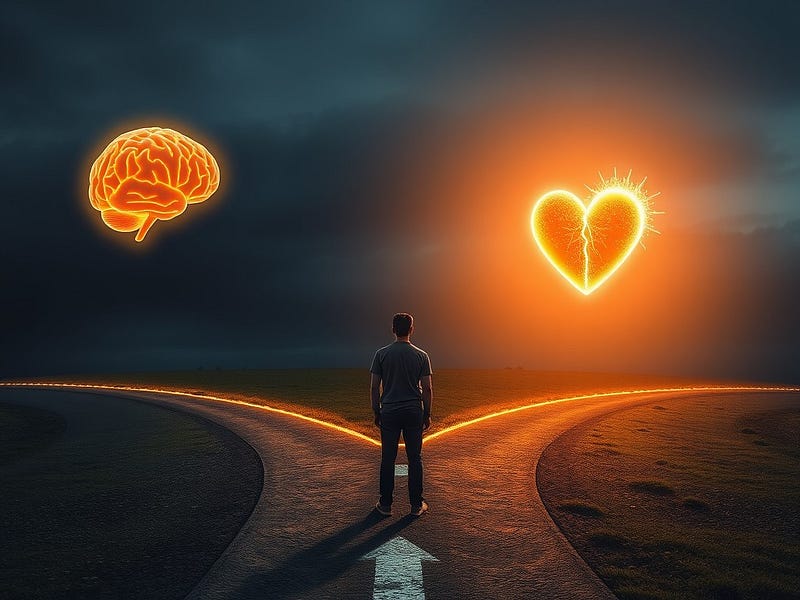
Discover how neuroscience challenges free will and why embracing this idea could change how you see responsibility, morality, and life itself.
There you are standing in front of a vending machine, trying to decide between a bag of chips or a chocolate bar. You think it’s your choice, right?
But what if I told you that your brain had already made the decision before you even realised it?
That’s the wild world of neuroscience and free will.
For years, I struggled with the idea that my choices might not be entirely my own.
It felt like losing control, like life was just a script I was following. But once I embraced the science behind it, I found a strange sense of freedom.
Let me share my journey of understanding how neuroscience challenges the concept of free will, why it’s not as scary as it sounds, and how it can actually make life easier.
Whether you’re a sceptic or just curious, stick around. This might change how you see everything.
The Illusion of Choice
I used to think every decision I made was mine alone. From what to eat for breakfast to major life choices, I believed I was in full control. But then I stumbled upon a study that shook my worldview.
In the 1980s, neuroscientist Benjamin Libet conducted an experiment where participants were asked to press a button whenever they felt the urge.
Libet found that brain activity predicting the decision to press the button occurred before the participants were consciously aware of making the choice [6].
This blew my mind. If my brain is making decisions before I even know it, how much control do I really have?
The Science Behind the Scenes
Research has only deepened this mystery.
Studies using fMRI scans show that our brains light up with activity related to decisions several seconds before we’re aware of making them.
It’s like your brain is the director, and your conscious mind is just the actor reading the lines [7].
For example, a 2008 study by Soon et al. found that brain activity could predict a participant’s choice up to 10 seconds before they were aware of it. That’s a long time in brain terms! [8]
At first, this felt unsettling. If my choices aren’t really mine, what’s the point of trying? But over time, I realised this perspective could actually be freeing.
Why Letting Go of Free Will Feels Liberating
Here’s the thing: Accepting that free will might be an illusion doesn’t mean life is meaningless. In fact, it can take a huge weight off your shoulders.
Less Guilt, More Compassion
I used to beat myself up over every mistake.
If I made a bad decision, I’d replay it in my head, wondering how I could’ve done better. But when I started to see my choices as the result of countless factors—my upbringing, my environment, even my brain chemistry—I felt less guilty [9].
This isn’t about shirking responsibility. It’s about understanding that we’re all products of our circumstances.
And if that’s true, maybe we can be a little kinder to ourselves and others.
Living in the Moment
Without the pressure of constantly second-guessing my choices, I found it easier to live in the present. If my brain is going to make decisions anyway, why not trust it and enjoy the ride? [10]
What About Morality?
One of the biggest concerns people have about free will is morality. If we don’t have control over our actions, how can we hold people accountable?
This was a tough one for me to wrap my head around.
Even if our choices are influenced by factors beyond our control, society still needs rules to function [11].
Think of it like this: If a car’s brakes fail and it causes an accident, we don’t blame the driver. But we still fix the brakes to prevent future accidents.
Similarly, understanding the science behind behaviour can help us create better systems to support people and reduce harm [12].
How to Cope with the Idea of No Free Will
If you’re feeling overwhelmed by all this, here are a few tips that helped me come to terms with it:
- Focus on what you can control: While your brain might make the big decisions, you can still influence your environment and habits [13].
- Practice self-compassion: Let go of the need to blame yourself for every little thing [9].
- Embrace curiosity: Instead of fearing the unknown, get curious about how your brain works [7].
- Connect with others: Share your thoughts and listen to different perspectives. It’s a great way to feel less alone in this big, complex world [10].
Wrapping Up
So, do we really have free will? Neuroscience suggests the answer might be no.
But instead of feeling like a puppet on a string, I’ve found this realisation to be incredibly freeing.
Letting go of the illusion of control has allowed me to live more fully, with less guilt and more compassion.
It’s not about giving up—it’s about understanding ourselves better and finding peace in the process.
If you’re still on the fence, that’s okay. The beauty of science is that it’s always evolving, and so are we.
Maybe the real choice is how we choose to see the world.
How do you see things—do you think you have free will? Let me know in the comments.
References
Please note that all cited references were checked at the time of this article’s publication. You may/may not have access to all the ones I had at the time I wrote this article.
- Benjamin Libet and the Denial of Free Will — Psychology Today
- Unconscious determinants of free decisions in the human brain — Nature
- Neuroscience of free will — Wikipedia
- Benjamin Libet’s Experiments on Free Will — U.OSU
- Benjamin Libet’s work on the neuroscience of free will — APA PsycNet
- The Libet experiment and its implications for conscious will — Semantic Scholar
- The place of Free Will: the freedom of the prisoner — PubMed
- Free Will and Moral Responsibility — Stanford Encyclopedia of Philosophy
- The Neuroscience of Free Will: Implications for Moral Responsibility — Frontiers in Psychology
- Determinism and the Illusion of Free Will — Scientific American
- How Neuroscience Challenges Our Understanding of Free Will — The Atlantic
- The Illusion of Conscious Will — MIT Press
- Free Will: A Very Short Introduction — Oxford University Press
Thanks for reading…
If you enjoyed reading my story, please highlight any parts you think other readers would find interesting.
A couple of claps 👏 wouldn’t go amiss, either.
Don’t forget to leave your comments about what you thought of this story.
Consider following me here on Medium and subscribing to my stories.
Discover more from nom@d learning
Subscribe to get the latest posts sent to your email.
 nom@d learning
Leave a comment