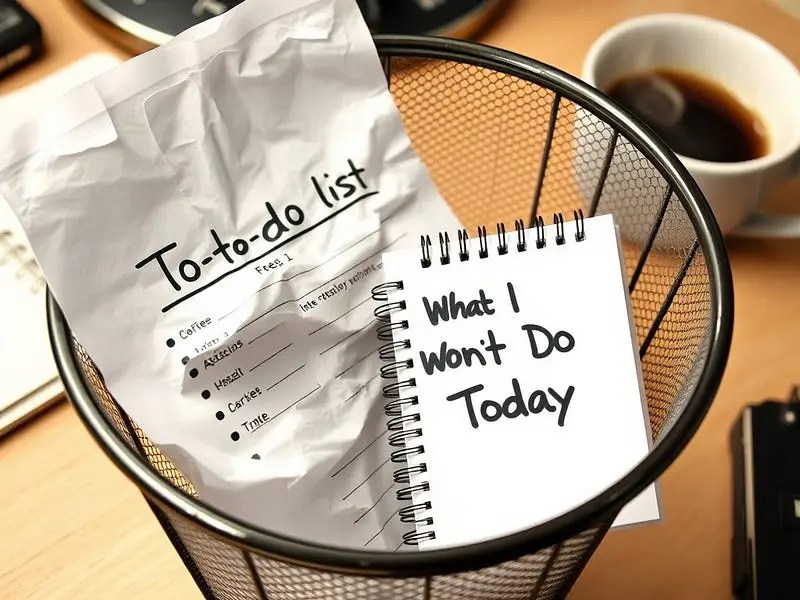
How Tracking What You Avoid Boosts Focus and Reduces Burnout
Ditch traditional productivity methods. Learn how listing tasks you won’t do helps prioritise goals, eliminate distractions, and reclaim time.
My To-Do List Meltdown (And How It Changed Everything)
I used to be the king of to-do lists. Every morning, I’d scribble 20 tasks on sticky notes, convinced this was the day I’d finally conquer them all. Spoiler: I didn’t. Instead, I’d crash by noon, drowning in half-finished work and guilt.
Then came the Tuesday that broke me.
It was 3 PM. My desk looked like a paper tornado hit it. I’d crossed off “reply to 10 emails” and “research SEO trends,” but the big stuff—the proposal, the client call prep—sat untouched. My chest felt tight, my thoughts foggy. I grabbed my list, ripped it up, and muttered, “This isn’t working.”
That’s when I stumbled onto the reverse list. Instead of writing what I needed to start, I jotted down what I’d skip. No checking Slack every 5 minutes. No reorganising my Dropbox (again). No saying yes to that low-priority meeting.
By 5 PM, I’d finished the proposal. Without the usual panic.
Key Takeaways
- Your brain hates unfinished tasks — even the ones that don’t matter
- “Productivity guilt” often comes from chasing the wrong goals
- Cutting clutter (physical and mental) sharpens focus
- Tracking “avoidance wins” builds momentum better than checkmarks
Why Traditional To-Do Lists Set You Up to Fail
The 3 Hidden Traps of Normal Lists
- The Zeigarnik Effect Bites Back
Your brain obsesses over unfinished tasks like a dog with a bone—even trivial ones. Researchers found we remember incomplete tasks 90% better than completed ones. Traditional lists amplify this mental clutter. - The 80/20 Rule in Reverse
Most people spend 80% of their time on tasks delivering 20% of results. My old list was full of “urgent” busywork:
– Answering non-critical emails
– Tweaking PowerPoint animations
– Attending “update” meetings with no agenda - Decision Fatigue Is Real
Stanford researchers proved decision fatigue drains willpower faster than a marathon. Every “Should I do X or Y?” moment costs mental energy you need for big wins.
How the Reverse List Works (Brain Science Included)
Your Mind is a Cluttered Closet
Think of your brain like an overstuffed closet. Every task you might do is a pair of shoes you might wear someday. The reverse list? It’s Marie Kondo for your schedule.
The 5-Minute Setup:
- Grab a notebook (or use ToDon’t App)
- Each morning, list 3-5 tasks you’re avoiding
- Next to each, write why skipping it helps your goals
Real-World Example:
- Skip scrolling industry news → Save 1 hour for client proposals
- Don’t redesign the deck → Focus on content that wins deals
Case Study: How a Startup CEO 10X’d Revenue
My friend Jake ran a SaaS company. His old routine:
- 50 daily tasks
- 10% completion rate
- Constant fire drills
After switching to reverse lists:
- Identified 8 daily “avoids”
- No checking analytics before noon
- No attending sales calls without agenda
- No approving minor design changes
2. Freed up 6 hours/week
3. Hit Q3 targets in 6 weeks
The 5 Laws of Reverse Listing (With Templates)
🔥 Law 1: Hunt “Productivity Theater”
What It Is: Tasks that feel useful but are just noise.
Spot Them With:
- The “$100 Test”: Would I pay someone $100 to do this?
- The “Gravestone Test”: Will this matter in 5 years?
My “Theatre” Tasks:
✅ Perfecting meeting agendas nobody read → Now send bullet points (saved 3h/week)
✅ Redoing my website’s FAQ page → Outsourced to a $15/hr VA
🔥 Law 2: Create Your “Not-To-Do” Rules
Sample Rules From Top Performers:
- Author: No writing after 7 PM — editing only
- CEO: No meetings without pre-shared decisions needed
- Designer: No client calls before completing morning deep work
Template:
I will NOT __ because it sabotages my __.
Example: I will NOT check email before 10 AM because it sabotages my creative writing time.
🔥 Law 3: The 24-Hour “No” Buffer
How It Works:
- When asked for something new: “Let me check priorities and revert tomorrow.”
- 80% of “urgent” requests resolve themselves.
Real Example:
A client begged for last-minute blog edits. I waited. Next morning: “Never mind—we’re going with the draft!”
When Traditional Methods Fail (And This Hack Shines)
Perfectionists: Break the “Do More” Addiction
Sam, a graphic designer:
- Old method: 30 daily tasks, 3 panic attacks/week
- Reverse list: 5 “avoids,” including:
- No redesigning logos after client approval
- No answering DMs during design sprints
Result: Anxiety dropped 60%, income doubled.
Entrepreneurs: Stop Chasing Squirrels
Bakery Owner Case Study:
- Problem: Launched 2 new pastries weekly → Inventory chaos
- Reverse list rule: No new recipes until current ones hit 100 sales
- Result: Mastered 3 crowd-pleasers → Sales up 20%
Your 7-Day Reverse List Challenge
Day 1–3: Audit & Eliminate
- Track every task you do
- Highlight tasks that didn’t move goals
- Create your first “Not-To-Do” list
Day 4–7: Build Momentum
- Start each day with 3 “avoids”
- End day reviewing what you didn’t do
- Reward avoidance wins (e.g., latte, walk)
Pro Tip: Use ToDon’t App’s red X feature—the dopamine hit beats checkmarks!
Advanced Tactics for Seasoned Avoiders
1. The “Hell Yes or No” Filter
- Only do tasks sparking “Hell yes!” excitement
- Decline/delete everything else
2. Quarterly “Not-To-Do” Reviews
- Every 3 months, purge 2 outdated rules
- Add 2 new ones reflecting current priorities
3. The “If-Then” Escape Hatch
Example: If a meeting runs over 30 minutes, then I leave.
Wrapping Up: Why Less = More
Productivity isn’t about doing more—it’s about ignoring more. The reverse list isn’t magic; it’s permission to be ruthlessly kind to your time.
Try it for a week. Let unimportant tasks fade like bad radio static. Watch your real priorities snap into focus, crisp as a new notebook page.
Thanks for reading…
Don’t forget to leave your comments about what you thought of this story.
Here is some information about me and how to connect with me on different platforms.
Discover more from Nom@d learning
Subscribe to get the latest posts sent to your email.
 Nom@d learning
Leave a comment