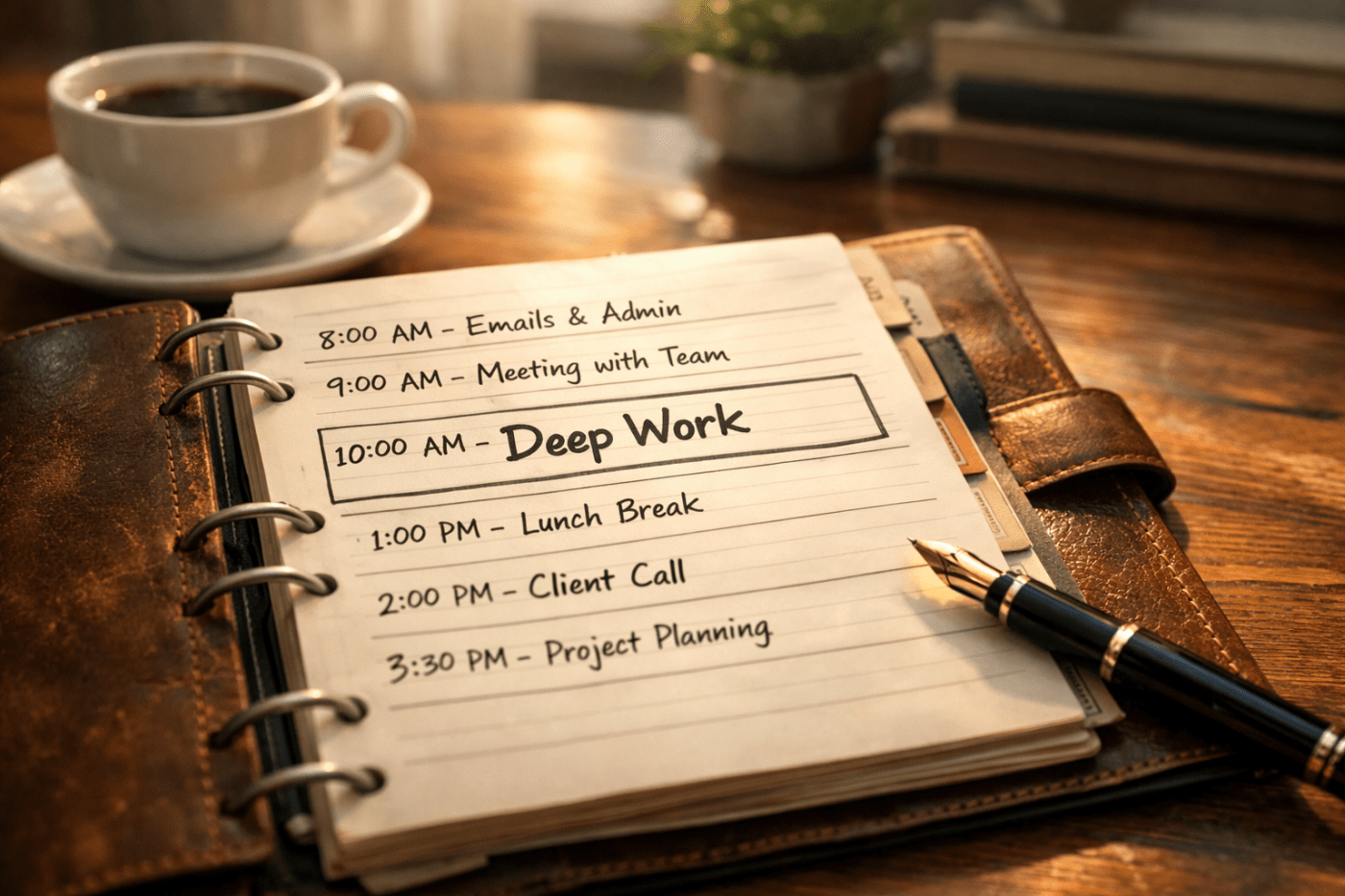
Stop letting other people’s priorities dictate your day. Learn the art of strategic time blocking to protect your focus. It helps to reduce anxiety. You can finally progress with the work that truly counts.
I remember staring at my screen one Tuesday evening. It was 5:30 PM, and the office was finally quieting down. I felt exhausted, depleted, and frankly, defeated. I had been ‘busy’ for nine straight hours. I had attended meetings, answered emails, and put out fires. Yet, looking at my primary project, I realised I had done absolutely nothing substantive.
This was not a unique day. Early in my career, while working on a project with a complex stakeholder group, this became my norm. My calendar looked like a block of Swiss cheese. It was full of holes—fifteen minutes here, thirty minutes there. I tried to squeeze work into those gaps, but it never stuck. I was drowning in shallow tasks while the deep, meaningful work remained untouched.
I eventually learned that the problem was not my work ethic. The problem was how I treated my time. I was letting my inbox dictate my life. I was reacting, not leading. Over time, I discovered that true productivity requires a defensive strategy. It requires building a fortress around your attention.
Key Takeaways
- Productivity is attention management, not time management; without guarding your focus, you can’t finish complex tasks.
- A calendar is a finite contract, unlike a to-do list, which is an infinite wish list that fuels anxiety.
- You must layer your day by scheduling deep work first, batching shallow tasks, and leaving buffers for the unexpected.
The Fragmented Attention Economy
The modern workplace is hostile to concentration. We reach the end of the day feeling drained, yet we often can’t point to a single significant achievement. This is the result of ‘attention residue’. Research suggests that the average professional is interrupted every 11 minutes.
The real cost is not just the interruption itself. It takes approximately 23 minutes to fully refocus after a distraction. When you check an email, a part of your brain remains fixated on that message. You are not fully present for the task at hand.
Cal Newport calls the resulting schedule ‘Swiss Cheese’. Your day is riddled with small, unusable gaps between obligations. In this environment, complex problem-solving becomes impossible. You are only using a fraction of your full potential. To correct this, we must shift our focus. We should shift our approach from managing time to managing attention. A solid structure must protect our focus.
The Philosophy: Why Lists Fail and Calendars Win
Most people rely on a to-do list. I used to be one of them. The problem with a to-do list is that it is an ‘infinite wishlist’. It ignores the constraints of reality. You can write down thirty tasks, but you only have eight hours. This discrepancy creates low-level anxiety. It focuses your mind on what you haven’t done.
A calendar is different. It is a finite map of your day. When you use time blocking, you force yourself to confront time scarcity. You can only fit so many blocks into the grid. A time-blocked calendar is a finite contract with your day. It forces you to make hard choices about prioritisation before the day begins.
This approach highlights the difference between deep work and shallow work. Deep work requires distraction-free concentration. It pushes your cognitive limits and produces high value. Shallow work consists of logistical tasks like email and meetings. These are easily commoditised. We are not trying to remove shallow work. We are simply containing it to protect the deep work.
The Method: Constructing the Fortress
Building a ‘Calendar Fortress’ requires a systematic approach. It is not about filling every minute but about assigning a job to every hour.
Step 1: The Brain Dump and Estimation
First, get every task out of your head. Write them down. Then, assign a time estimate to each. Be careful here. We often fall for the ‘planning fallacy’, where we underestimate how long things take. If you expect that a report will take one hour, it is wise to schedule two.
Step 2: The Three Defensive Layers
This is the core structure I used when working with a team to turn around a failed programme.
- Layer 1: The Macro Block. Dedicate a 2–4 hour window for your ‘One Big Thing’. This is your deep work block. It is non-negotiable.
- Layer 2: The Batch Block. Group administrative tasks. Instead of checking email constantly, schedule two 30-minute windows. One at 11:30 AM and one at 4:30 PM.
- Layer 3: The Buffer Block. Schedule ’empty’ time. I usually set aside 30 to 60 minutes. This absorbs the inevitable crises. If no crisis happens, you gain bonus focus time.
Step 3: The Tetris Game
Now, slot these layers into your calendar. Create a visual map of your day. Seeing the blocks helps you spot conflicts right away. It transforms abstract intent into a concrete plan.
Advanced Tactics: Customising the Defence
You might argue that you can’t block time because you are a manager. I faced this challenge when I moved from a specialist role to leading a department. Paul Graham describes this as the conflict between the ‘Maker’s Schedule’ and the ‘Manager’s Schedule’.
Makers need long, uninterrupted blocks. Managers live in hour-long chunks. The solution is a hybrid model. Protect your mornings for strategy and ‘maker’ work. Open your afternoons for collaboration. A blocked calendar also signals scarcity. It encourages your team to solve minor problems independently.
You should also consider your biology. This is where energy management for peak performance comes into play. If you are a ‘lark’ (early riser), block 7–10 AM for deep work. Your focus block, if you’re an ‘owl’, might be from 8 to 11 PM.
Technology can help here. Tools like Motion or Reclaim.ai use AI to reshuffle tasks around meetings. Nonetheless, some executives are going the other way. They are adopting ‘monk mode’, dedicating entire days offline to reject meeting culture entirely.
Handling Breach: When Reality Hits
The enemy of time blocking is rigidity. You might think this method fails the moment an urgent demand lands on your desk. This is incorrect. Time blocking is not about perfection. It is about having a plan that allows for deviations.
Adopt a flexible mindset when faced with interruptions. Don’t remove the block; move it. Treat the blocks as movable tiles, not fixed stone. This adaptability is key to resilience in a chaotic work environment.
Finally, you must end the day correctly. Cal Newport suggests a ‘shutdown ritual’. Review your calendar for tomorrow. Close open loops. This prevents work anxiety from ruining your sleep. It signals to your brain that the workday is officially over.
Conclusion: The Integrity of Time
Time blocking is more than a productivity hack. It is an act of integrity. When we let our days be consumed by other people’s priorities, we drift into ‘performative busyness’. We look busy, but we are not advancing our core purpose.
Aligning your daily actions with your core values is a step towards authentic growth. A reclaimed calendar is the ultimate sign of a professional who respects their potential. Build the fortress. Protect your mind. Do the work that matters.
Wrapping Up
Reclaiming your calendar requires courage. It forces you to say no to the trivial so you can say yes to the vital. By shifting from a reactive to-do list to a proactive schedule, you gain control. You reduce anxiety and create space for the deep work that defines a career. Start tomorrow with just one protected block.
🌱 Reclaim Your Calendar: The Growthenticity Connection
The core ideas explored in this article aren’t just isolated concepts; they deeply resonate with the principles of what I call ‘Growthenticity’:
‘The continuous, integrated process of becoming more oneself (authentic) through leading with questions, learning through action, and growing by embracing uncertainty and imperfection, all fuelled by curiosity.’
Time blocking is a practice of self-discovery. It asks you to question what truly matters. It demands action by forcing you to define your day. Most importantly, it requires you to embrace imperfection. You will not have a perfect day every time. The goal is not a flawless schedule. Instead, it involves the curiosity to learn how you work best. It also requires the courage to protect that process.
👉 I encourage you to check out my paid Substack offerings at Lead, Learn, Grow. You can further explore concepts like ‘Growthenticity’. You will also gain access to practical tools and connect with a supportive community. This community focuses on encouraging authentic and impactful growth.
Join us as we unpack these ideas and support each other on our journeys.
🌱 Learn more about me and what I offer my free and paid Substack subscribers.🌱
Here is some information about me and how to connect with me on different platforms.
Your Turn
What is the one ‘deep work’ task you have been putting off because you ‘don’t have time’? Where could you fit a two-hour block for it next week?
Discover more from nom@d learning
Subscribe to get the latest posts sent to your email.
 nom@d learning
Leave a comment