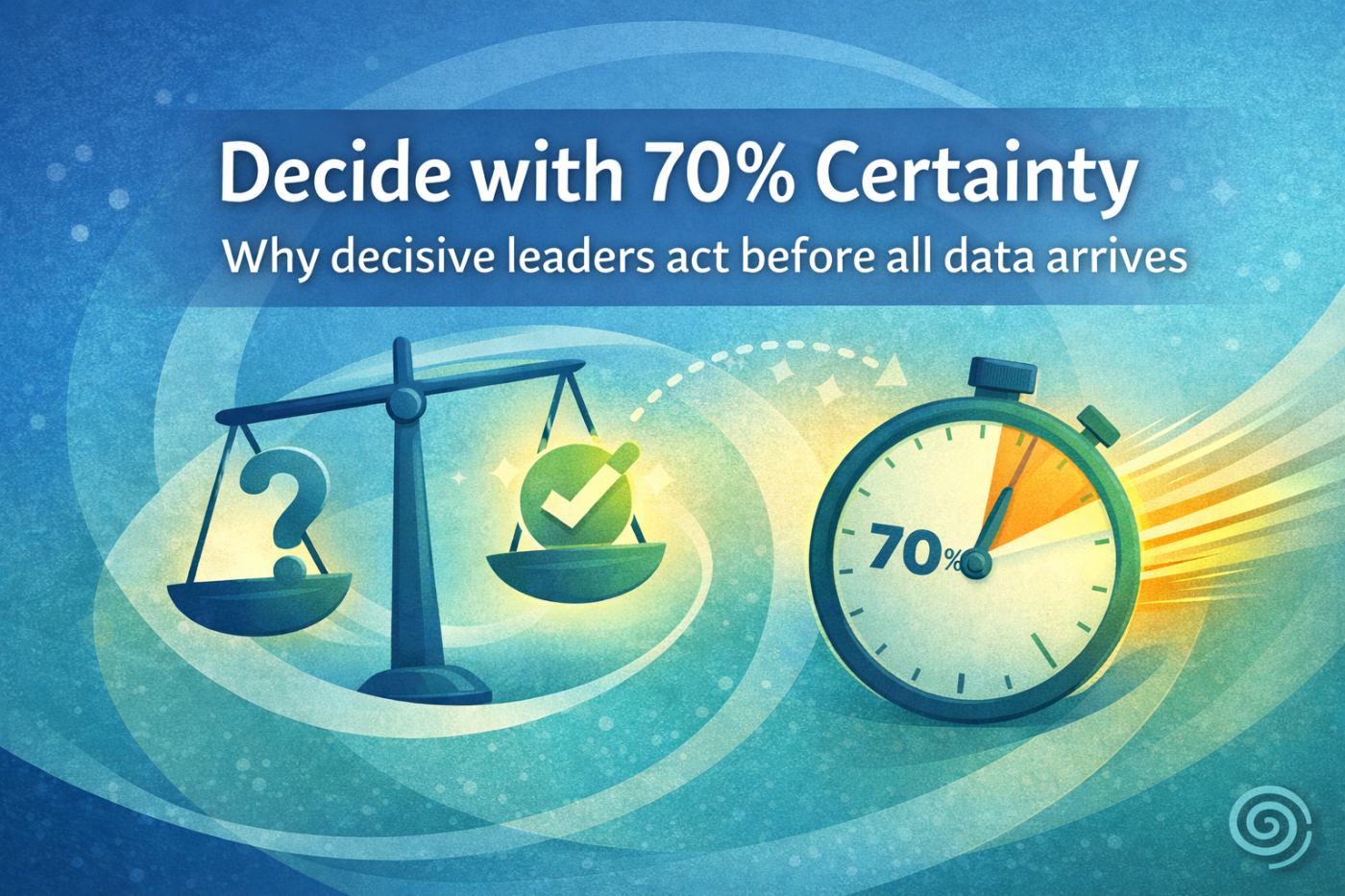
How to escape analysis paralysis, distinguish between reversible and irreversible choices, and turn speed into your ultimate competitive advantage.
Working with teams taught me something unexpected: even smart people freeze. We would sit in bright meeting rooms, staring at spreadsheets, asking for just one more data point. We thought we were being responsible. We believed that more analysis would guarantee a better outcome. We were mistaken.
I learned the hard way that waiting for perfect information is a form of fear. While we polished our plans, others launched imperfect products and learned from real-world feedback. They overtook us not because they were smarter, but because they were faster. They understood that in business, speed is a function of quality.
This hesitation creates a bottleneck that stifles growth. It keeps leaders stuck in the weeds, reviewing minor details instead of setting direction. Over the years, I have found that the most effective leaders do not make the ‘right’ calls every time. Instead, they master decision-making strategies that prioritise speed and correction over flawless execution.
Key Takeaways
- The 70% Rule: Waiting for complete information guarantees you will be late. Acting with 70% certainty achieves a balance between speed and informed risk.
- Two-Way Doors: Distinguish between reversible decisions, which should be made quickly, and irreversible ones, which need deep deliberation.
- Correction Velocity: Success does not come from getting it right the first time. It comes down to how fast you can fix it when you are wrong.
The Perfectionist’s Trap
Leaders today face a paradox. We have more data than ever, yet we struggle to act. We are drowning in reports but starving for conviction. Many of us grew up with the legacy mindset that a leader’s job is to be right. We treat every choice like a final exam.
High-performing groups operate differently. They accept that the goal is not to be perfect. The goal is to be fast and correctable. They understand that most decisions are temporary.
Jeff Bezos famously said that if you wait for 90% of the information, you are likely too slow. I have seen this play out in projects where I was working as a consultant. We would delay a launch to mitigate every possible risk. By the time we approved it, the market had shifted. The ‘perfect’ decision became the wrong one simply because it arrived too late.
The 70% Protocol Explained
To move faster, we need a new threshold for action. Think of your information level as a percentage.
If you have less than 40% of the information, you are guessing. This is reckless. You are essentially gambling with your resources.
Waiting for 90% or 100% will lead to analysis paralysis. You have traded opportunities for comfort. The train has already left the station.
The sweet spot is 70%. You know enough to set a clear direction. You have identified the major risks. You do not have total certainty, but you have directional accuracy.
Acting at 70% feels uncomfortable. It requires embracing uncertainty. In my career, I had to learn to trust intuition when the data ended. This aspect is where Decision Intelligence (DI) plays a role today. Modern leaders use AI for a different purpose. AI helps them reach that 70% confidence level faster than their rivals. They do not aim to predict the future perfectly.
The Framework: One-Way vs. Two-Way Doors
Not all risks are equal. To make decisions quickly without destroying value, you must categorise them. I use the ‘door’ analogy.
Type 1 Decisions (One-Way Doors)
These choices are irreversible. Once you walk through, you can’t go back. Examples include selling a division, a massive rebrand, or ending a major partnership. These need caution. You should walk through these doors slowly. You need near-complete information here. This is high-stakes decision-making.
Type 2 Decisions (Two-Way Doors)
These decisions are reversible. If you get it wrong, you can simply turn around and walk back through the door. Examples include trying a new marketing tagline, changing a meeting format, or testing a feature.
Because the cost of being wrong is low, the real protocol here is speed. Perfection is the enemy.
The fatal mistake I saw in many organisations was treating Type 2 decisions as if they were Type 1.
We would form committees to approve something as simple as a software licence. That bureaucracy kills momentum.
‘Founder Mode’ is designed to fix this. It flips the hierarchy. Everyday decision-making is pushed to the front lines. People can move quickly on low-risk choices without getting trapped in approval loops.
The Hidden Metric: Cost of Delay vs. Cost of Error
Traditional management obsesses over the cost of error. We ask, ‘What happens if we screw this up?’ This is a valid question, but it is incomplete.
We rarely ask, ‘What is the cost of waiting another week?’
This is the cost of delay. In fast-moving markets, losing first-mover advantage often costs more than a mistake. You risk missing the holiday season. This scenario can happen if you postpone a product launch by six months to fix minor bugs. The revenue loss from the delay often dwarfs the cost of patching the bug later.
We must shift our focus. We need to move away from seeking ‘Big Data’ reports. These reports explain the past. Instead, we should seek ‘Fast Insights’ that inform the present. We must value agility over safety.
Velocity Through Correction
Speed is not just about the moment you decide. It is about the speed of correction.
If you move fast, you will make mistakes. This is a feature, not a bug. By making more decisions per month, you run more experiments. You gather real-world data.
Even if 20% of your choices fail, you learn from them months earlier than a risk-averse competitor would. This approach treats quantity as a form of quality.
The goal shifts from ‘Perfection’ to ‘Correction Velocity’. How fast can we admit we were wrong and fix it? This mindset requires continuous learning. You must be willing to unlearn your original assumption the moment the data proves you wrong.
The Cultural Enabler: Disagree and Commit
The biggest drag on velocity is often the need for consensus. In meetings I attended, we would circle the same topics endlessly. We waited for everyone to nod in agreement.
This behaviour is dangerous. It gives veto power to the most cautious person in the room.
The principle of ‘Disagree and Commit’ breaks this deadlock. Teams must debate vigorously. You should share your concerns. But once the decision is logged—even at 70% certainty—everyone must support it. You can’t sabotage the effort because you voted no.
Such an approach requires collective alignment. Modern teams are supporting this by moving to asynchronous decision-making. Writing memos allows people to think deeply and dissent clearly without slowing down the actual decision process with endless meetings.
Action Plan: How to Implement the Protocol
You can start using this today. You do not need a new title to change how you work.
- Audit Your Decisions Look at the last five decisions that stalled. Were they Type 1 or Type 2? You will likely treat reversible choices as permanent ones.
- Set Data Deadlines Stop ‘polishing the pebble’. Give yourself a strict time limit to gather facts. If you don’t have the answer by Tuesday, decide with what you have.
- Delegate the Reversible If a decision is a two-way door, push it down. Let others make the call. This step is key to empowering teams and freeing yourself for the big risks.
- Celebrate Fast Failures Create a safe space for error. Praise a wrong decision made quickly if it was corrected fast. Criticise the right decision if it took six months too long to make.
Wrapping Up
Perfection is an illusion. In the complex world of work, we can never know everything. Speed is a tool that allows us to navigate the unknown.
By distinguishing between reversible and irreversible choices, we free ourselves to act. We stop staring at the door and start opening it. The risk isn’t in moving too fast; it’s in standing still while the world moves on.
🌱 Decide with 70% Certainty: The Growthenticity Connection
The core ideas explored in this article aren’t just isolated concepts; they deeply resonate with the principles of what I call ‘Growthenticity’:
‘The continuous, integrated process of becoming more oneself (authentic) through leading with questions, learning through action, and growing by embracing uncertainty and imperfection, all fuelled by curiosity.’
Trusting the 70% rule requires the courage to embrace imperfection. It asks us to admit we do not have all the answers. This vulnerability is authentic. It forces us to lead with questions rather than commands. We act before we are ready. By doing so, we commit to learning through action. We grow stronger not by avoiding errors but by navigating them with curiosity.
👉 I encourage you to check out my paid Substack offerings at Lead, Learn, Grow. You can further explore concepts like ‘Growthenticity’. You will also gain access to practical tools and connect with a supportive community. This community focuses on encouraging authentic and impactful growth.
Join us as we unpack these ideas and support each other on our journeys.
🌱 Learn more about me and what I offer my free and paid Substack subscribers. 🌱
Here is some information about me and how to connect with me on different platforms.
Your Turn
What is one ‘two-way door’ decision you are now over-analysing? What would happen if you just made the call today?
Discover more from nom@d learning
Subscribe to get the latest posts sent to your email.
 nom@d learning
Leave a comment