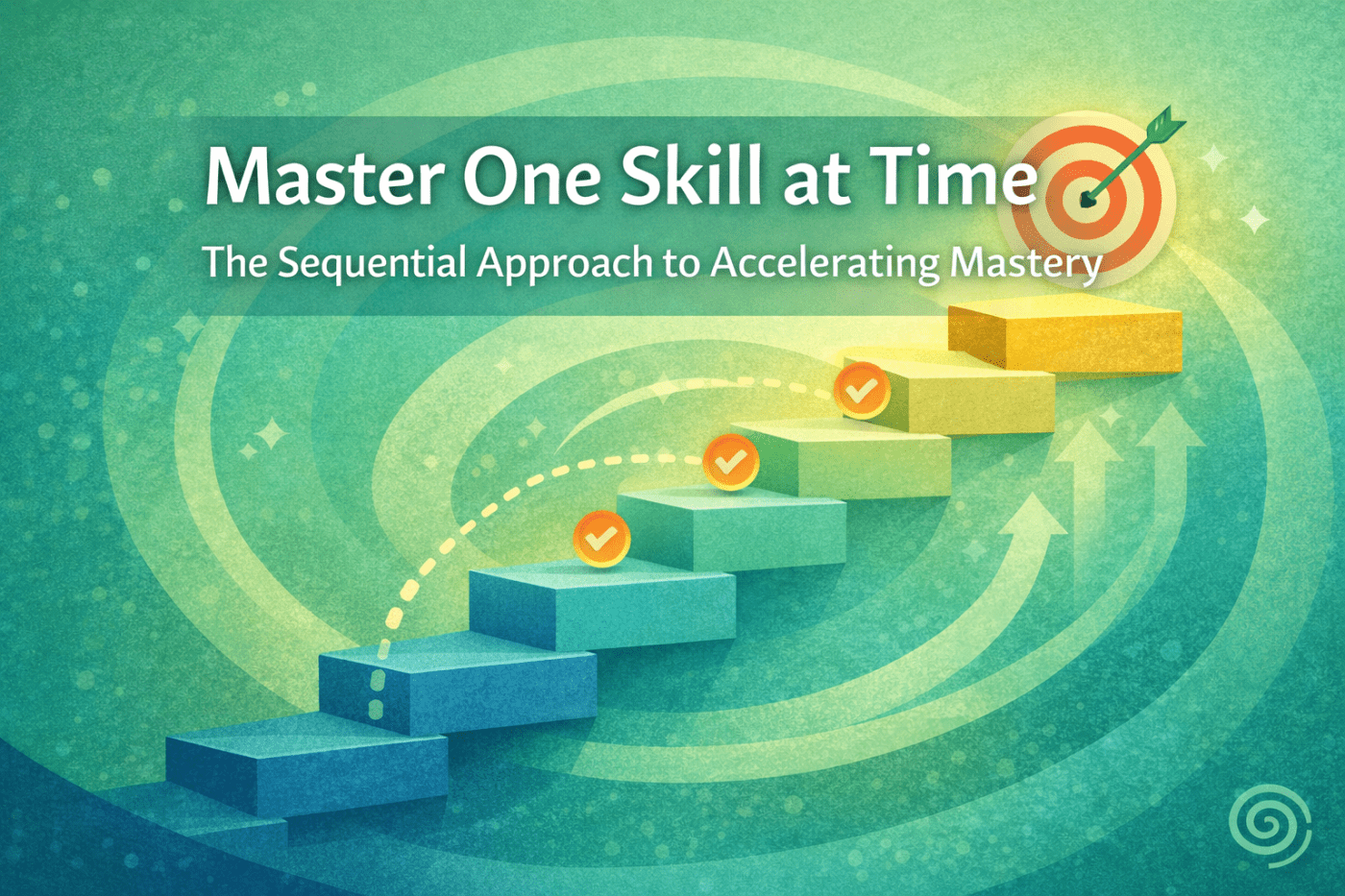
Stop juggling and start building: how focused immersion beats scattered effort in the age of distraction.
I remember a specific initiative I worked on with a large organisation a few years ago. The goal was ambitious. We wanted to uplift the capability of the entire workforce. We introduced a new project management method, a new software platform, and a new communication framework all at once. The intention was good. We wanted to move fast.
The result, nevertheless, was chaos. People were not learning. They were surviving. I watched talented colleagues struggle to recall basic steps in the software. Their minds were busy processing the new project terminology. They were overwhelmed. The error rates spiked. Morale dropped. It was a classic case of cognitive overload.
In my experience working with teams across various sectors, I have seen this pattern repeat itself constantly. We treat our brains like computers with infinite RAM. We run five heavy applications at once. But ‘human wetware‘ does not work that way. When we try to learn everything at the same time, we often end up learning nothing effectively.
It took me years to realise this truth. The fastest way to build a robust set of skills is not to multitask. It is to slow down. It is to focus intensely on one thing until it sticks. Then, and only then, do you move on to the next. The result is the power of sequential mastery.
Key Takeaways
- Multitasking hurts retention: trying to learn multiple complex skills at once creates a bottleneck in your brain’s working memory.
- Sequential focus builds speed: mastering one skill creates a foundation that makes learning the next skill significantly faster and easier.
- Momentum requires wins: focusing on one area lets you see progress quickly, which fuels the motivation to keep going.
The Modern Trap
We live in a culture that rewards ‘busyness’. We constantly experience pressure to multitask.
- We want to be the manager who knows coding.
- We aim to be the marketer who understands data science.
- We strive to be the leader who speaks three languages.
This anxiety drives us to pile these goals onto our plates simultaneously.
- We listen to a Spanish podcast while checking emails.
- We take a coding course on our lunch break while trying to master a new leadership theory.
I have fallen into this trap myself. I tried to study finance while learning a new technical standard. As a result, I developed a superficial understanding of both subjects and experienced significant fatigue.
This is the ‘Shallow Progress Trap’. We divide our attention so thinly that we never reach true competence. We stay in the novice phase forever. We constantly restart. We never get past the hard part. This approach often leads to exhaustion rather than growth. We need effective burnout prevention strategies to avoid this.
Serial mastery offers a different path. It is counter-intuitive. It asks you to ignore 90% of your goals right now so you can achieve 100% of them eventually. It is a rejection of performative hustle. It aligns with an authentic approach to growth. It prioritises depth over breadth in the short term to achieve massive breadth in the long term.
The Neuroscience of Focus (Why Multitasking Fails)
Our brains have limits. Cognitive Load Theory explains this well. Our working memory is a bottleneck. It can only hold a small amount of new information at one time. When you try to learn a new syntax and a new language simultaneously, you jam the bottleneck.
The biology is clear. The brain can’t process two heavy cognitive loads at once. It must switch between them. This creates a ‘switching cost’. Research suggests that dividing attention can erode retention rates by up to 40%. That is a massive loss.
Every time you switch contexts, you pay a tax on your mental energy. You have less fuel left for actual learning. I have observed such effects in workshops. Participants who checked their phones during breaks struggled to retain concepts compared to those who rested.
True learning requires neural myelination. This is the process of insulating nerve fibres to increase signal speeds. This happens through deep, repetitive firing of the same neural circuits. Scattered attention results in scattered firing. Focused immersion leads to faster, stronger pathways. To truly learn, we must protect our focus.
The ‘Domino Effect’ of Competence
Skills are not isolated silos. They are building blocks. When you master one skill, you often acquire mental models that apply to other skills. This technique is called neural reuse. The brain uses existing architecture to help you learn new things.
Think of it as compound interest for your brain.
If you learn how to read financial reports (Skill A), you are not just learning finance. You are learning logic. You are learning pattern recognition.
When you later try to learn market analysis (Skill B), you can reuse those logic patterns. You learn Skill B twice as fast.
I like to visualise this as a line of dominoes. The first domino is the heaviest. It takes a lot of energy to push it over. You have to heave against it. But once it falls, it knocks over the next one with ease. The momentum builds.
If you try to push five heavy dominoes at once, none of them move. If you focus all your energy on the lead domino, the rest follow. Mastering one challenge also teaches you learning how to learn. You become more efficient for the next challenge.
Historical Proof: The Franklin Method
This is not a new idea. Benjamin Franklin understood this centuries ago. He wanted to improve his character. He identified 13 virtues he wanted to embody, like temperance, silence, and order.
He did not try to fix his entire character overnight. He knew that would fail. Instead, he used a method of ‘serial monotasking’. He dedicated one full week to strict adherence to a single virtue. During that week, he focused only on Temperance.
He tracked his progress on a chart. Once the week was done, he moved to the next virtue. He cycled through them repeatedly. He did not try to be perfect in everything at once. He built consistent habits over time.
This historical example is a precursor to modern habit stacking. It works because it respects the subconscious mind. It allows a behaviour to become automatic before adding a new load. It turns a struggle into a routine.
The Framework: The Sequential Protocol
How do we apply this today? I recommend a three-phase approach.
Phase 1: Selection (The Lead Domino)
You must choose one skill. Just one. This is the hardest part. You must identify the ‘Lead Domino’. Ask yourself: What is the one skill that, if mastered, would make everything else easier or irrelevant?
It could be data analysis or public speaking.
In the modern workforce, we are moving towards skills-based organisations. Employers care less about degrees and more about specific, demonstrable competencies. Choose one of these essential skills. Ignore the rest for now.
Phase 2: Immersion (Monk Mode)
Once you choose, go deep. This is often called ‘Monk Mode’. Set a specific period. Six weeks is a good timeframe. During these six weeks, you focus exclusively on that skill.
- You read books on it.
- You practise it every day.
- You ignore other learning goals.
The result is deep engagement. It contrasts sharply with micro-credentialing, where people often skim the surface of many topics. You are looking for depth. You want to rewire your brain.
Phase 3: Maintenance & Stacking
After your immersion period, you will hit a level of competence. The skill becomes easier. It requires less mental effort. Now you can put it on ‘maintenance mode’.
You could practise it once a week to keep it sharp. Now, you have the bandwidth to select your next lead domino. You stack the new skill on top of the old one. This procedure is how you build a skyscraper. You lay one floor at a time.
Psychological Safety and Momentum
Motivation is fragile. It dies when we do not see progress. This is known as the Progress Principle. When you try to learn five things at once, your progress in each is microscopic. It feels like stagnation.
This situation kills your drive. You feel like you are working hard but getting nowhere. Yet, when you focus on one tool, you get definitive wins. You master a specific task. You write a working script. These small wins release dopamine.
This builds self-efficacy. You start to believe you can learn. This confidence is vital. It helps you push through the ‘Boredom Barrier’. We often switch tasks because we crave novelty. We get bored when things get hard.
We need to sit with that discomfort. We need the psychological safety to admit we are beginners. By focusing on one thing, we see the finish line. We push through the boredom because we can feel the mastery approaching.
Conclusion
The fable of the tortoise and the hare was right. Slow and steady really does win. In a world where AI can automate shallow tasks instantly, deep, specialised mastery is the new premium asset. The generalist who knows nothing deeply is at risk.
Sequential mastery is not about doing less. It is about achieving more. It respects the biological limitations of your brain. It harnesses the power of focus. It builds a professional life that is solid, not hollow.
I challenge you to identify your lead domino today. Do not pick three. Pick one. Commit to it for 30 days. Give it your full attention. Watch how much faster you grow when you stop running in circles. This is how you build a lasting professional legacy.
Wrapping Up
Multitasking is a myth that holds us back. By embracing a sequential approach to learning, we reduce cognitive load and accelerate genuine competence. It requires patience to start, but the momentum it builds is unstoppable. Pick your one skill, go deep, and let the results compound.
🌱 Master One Skill at a Time: The Growthenticity Connection
The core ideas explored in this article aren’t just isolated concepts; they deeply resonate with the principles of what I call ‘Growthenticity’:
‘The continuous, integrated process of becoming more oneself (authentic) through leading with questions, learning through action, and growing by embracing uncertainty and imperfection, all fuelled by curiosity.’
Sequential mastery requires us to embrace imperfection. It asks us to admit we can’t do it all at once. It demands the humility to sit with the discomfort of being a beginner in one area while ignoring others. This honest assessment of our capacity is an act of authenticity. It moves us away from the performative ‘hustle’ and towards a grounded, curious engagement with our own growth.
👉 I encourage you to check out my paid Substack offerings at Lead, Learn, Grow. You can further explore concepts like ‘Growthenticity’. You will also gain access to practical tools and connect with a supportive community. This community focuses on encouraging authentic and impactful growth.
Join us as we unpack these ideas and support each other on our journeys.
🌱 Learn more about me and what I offer my free and paid Substack subscribers.🌱
Here is some information about me and how to connect with me on different platforms.
Your Turn
If you could pause everything else, what one skill would you master over the next six weeks? What would your ‘Lead Domino’ be?
Discover more from nom@d learning
Subscribe to get the latest posts sent to your email.
 nom@d learning
Leave a comment